In this story
Midnights asks what happens when a thought has a whole room to itself. Memories become saturated, confidence becomes a performance and an imagined conversation can outlast the person it concerns. The original thirteen-song sequence moves between those conditions without requiring the night to have one emotional meaning.
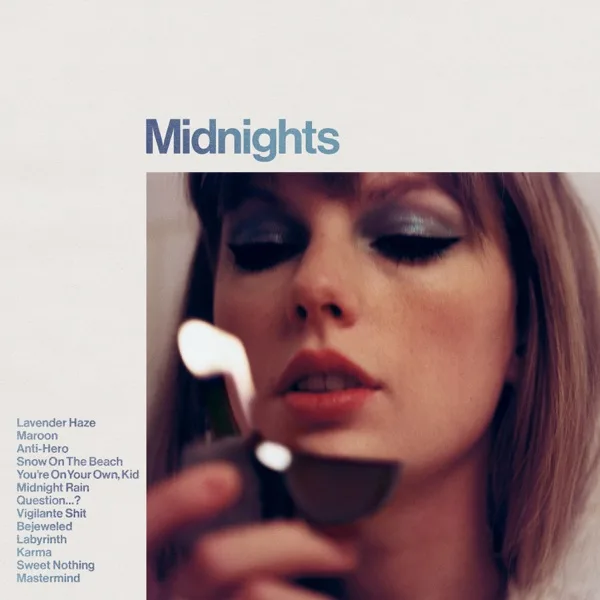
Released on October 21, 2022, the standard edition begins with Lavender Haze and ends with Mastermind. Its most rewarding details often sit below the immediate hook: a voice that changes apparent size, a low pulse that holds a scene still, or a restrained verse that becomes a much larger recollection. The track-by-track notes below focus on those changes. [1]
Listen to the album
Play the original standard edition while you explore the songs.
Tracklist [2][6]
-
01
Lavender Haze3:22 Listen ↗
Listening note
The steady groove creates a mood to remain inside rather than an entrance that quickly gives way to something else. Listen to the relationship between the close vocal and the soft-edged background. The song’s wish to protect a feeling has a musical counterpart in how firmly it holds its atmosphere.
-
02
Maroon3:38 Listen ↗
Listening note
Low frequencies and a measured pace make recollection feel heavy and saturated. The vocal does not have to hurry for the scene to gain intensity. Notice how repeated details gather emotional weight: the song is revisiting an encounter whose colors seem easier to recover than its resolution.
-
03
Anti-Hero ↗3:20 Listen ↗
Listening note
The approachable melody turns an uneasy self-portrait into something easy to sing along with. That accessibility is part of the tension. Listen for the matter-of-fact delivery beside the more exposed chorus; self-awareness keeps returning, but the return does not automatically reduce the problem it recognizes.
-
04
Snow On The Beach (feat. Lana Del Rey)4:16 Listen ↗
Listening note
The floating texture makes a mutual feeling seem both real and improbable. Lana Del Rey’s presence is integrated into the original recording’s softer vocal world. This is the standard album version; the later Til Dawn track explicitly billed as featuring more Lana Del Rey offers a different vocal balance.
-
05
You're On Your Own, Kid ↗3:14 Listen ↗
Listening note
The song moves from a restrained opening toward a larger emotional frame. Its title gains different weight as longing and ambition become part of the same remembered life. Follow the accumulation toward the later passages: solitude begins to sound like something the speaker can move through, as well as something they must face.
-
06
Midnight Rain2:54 Listen ↗
Listening note
The lowered vocal sound makes the recurring phrase feel different from the surrounding narration. The contrast gives the memory two apparent distances: a person describing it and a transformed voice carrying its refrain. The compact running time makes those changes particularly noticeable rather than allowing them to dissolve into a long atmosphere.
-
07
Question...?3:30 Listen ↗
Listening note
The repeated questions keep an encounter open after its participants have moved beyond the immediate scene. Listen to how the polished rhythm carries an unresolved conversation. Its momentum can sound assured even while the narrator keeps asking for an interpretation they cannot quite obtain.
-
08
Vigilante Shit2:44 Listen ↗
Listening note
The arrangement leaves conspicuous space around a tightly controlled vocal. That restraint makes the confrontation feel deliberate rather than explosive. After the more crowded memories of the preceding songs, the reduction changes the temperature of the room and makes each short gesture carry more weight.
-
09
Bejeweled3:14 Listen ↗
Listening note
Bright details and a buoyant pulse make visibility feel pleasurable. The song’s confidence is active: the speaker enters a space and claims attention. Its position after Vigilante Shit makes the shift especially clear, from controlled confrontation to an outward display that enjoys its own sparkle.
-
10
Labyrinth4:07 Listen ↗
Listening note
The suspended atmosphere makes a newly arriving feeling seem fragile and difficult to process. Listen to the spaces around the vocal and the way the texture stretches time. Following Bejeweled, the song slows the pace without simply abandoning intensity; uncertainty becomes the source of its pressure.
-
11
Karma3:24 Listen ↗
Listening note
The relaxed bounce gives imagined balance an easy, almost playful quality. The pleasure is less in controlling every consequence than in believing the world can move favorably around the speaker. The original standard track is the solo recording; the later Ice Spice collaboration belongs to another edition.
-
12
Sweet Nothing3:08 Listen ↗
Listening note
A smaller instrumental frame brings attention back to an intimate exchange. The repeated movement has the quality of a familiar room rather than a public declaration. Its quietness matters in this position: after Karma’s outward ease, relief can also mean being asked for very little.
-
13
Mastermind3:11 Listen ↗
Listening note
The closing disclosure revisits the difference between an apparent accident and an intended encounter. The steady motion gives the confession a carefully arranged setting. Listen to the final change in perspective: understanding between two people may depend less on perfect concealment than the speaker initially imagined.
Start with three different kinds of night
Anti-Hero offers the most direct entrance. Its melodic accessibility gives self-criticism a form an audience can easily share. That makes the central tension harder to dismiss: recognizing a difficult pattern does not necessarily mean escaping it. The song can sound conversational and uneasy at the same time.
Midnight Rain is a useful second stop because the voice itself becomes part of the scene. The lowered vocal sound gives the recurring phrase a different presence from the more direct narration around it. The change makes memory feel processed, as though the same experience can return in an altered shape.
Sweet Nothing offers a third route into the album. The smaller arrangement and gently repeated movement value a space where the speaker is asked for less. Played beside Anti-Hero’s internal pressure and Midnight Rain’s unsettled recollection, it makes quietness sound like a particular kind of relief rather than an absence of drama.
Voices, low end and an enclosed room
The Recording Academy’s Album Of The Year credits list Jack Antonoff and Taylor Swift as the album’s producers. The sonic world they build here frequently gives a voice the sense of occupying an interior: soft-edged textures, pronounced low frequencies and details that move around a relatively close vocal.
Lavender Haze establishes that world through a steady groove. Maroon makes it denser, with recollection seeming to accumulate color and weight. Neither song needs constant dramatic acceleration. Their power comes partly from maintaining an atmosphere long enough for small changes to become significant.
The album then tests how little of that room a song needs. Vigilante Shit strips the surroundings back and lets tightly controlled delivery carry the confrontation. Labyrinth stretches hesitation through sustained space. Bejeweled fills the frame with brighter, more conspicuous details. The sound remains recognizable while the speaker’s relationship to it changes. [4]
The first five songs widen the frame
The opening sequence begins in a sustained mood, moves into a richly colored recollection, then turns the scrutiny toward the self. Lavender Haze, Maroon and Anti-Hero form a revealing run: an attempt to preserve a feeling, an inability to make a memory small and an uneasy recognition of one’s own role.
Snow On The Beach changes the pressure. Its softer, floating texture allows the arrival of a shared feeling to seem improbable and delicate. The atmosphere is still nocturnal, but the speaker’s attention can briefly move away from defending a position or judging a past scene.
You’re On Your Own, Kid then broadens the record’s timescale. Longing becomes aspiration, and private memories gather into a larger account of growing into a life. The musical expansion helps that movement feel earned. At this point the night holds more than a relationship: it holds a history that the speaker is learning to carry.
Doubt, revenge and the pleasure of being seen
The middle of the album refuses a single model of confidence. Question…? keeps returning to an unresolved encounter. Vigilante Shit narrows its delivery into a controlled confrontation. Bejeweled gives attention a more pleasurable role, turning visibility into something the speaker chooses to claim.
Those shifts make the glitter useful. It arrives after songs in which the speaker has been uneasy about their part in an interaction or determined to manage the consequences. The brighter sound allows confidence to feel like an action taken in a particular moment, rather than proof that every earlier doubt has disappeared.
Labyrinth follows that display with a tentative emotional movement. Its suspended atmosphere slows the momentum and makes the arrival of a feeling difficult to name with certainty. The placement keeps the album from treating self-possession as a permanent solution. Different songs need different ways of moving through the same long night.
Three ways to let the pressure out
The final run gives relief three distinct forms. Karma enjoys an imagined balance in the world outside the speaker. Sweet Nothing reduces the scale to a private exchange and a smaller room. Mastermind then returns to the question of control, presenting a final disclosure about the apparent accidents that brought an encounter together.
The sequence matters because each song changes what ease can mean. Pleasure can come from feeling fortunate, being allowed to stop performing or finding that another person already understands the performance. The album leaves those possibilities together rather than selecting one as a cure for everything that preceded them.
Mastermind also changes how the opening can be remembered. What first appeared as a protected mood now belongs to a record deeply concerned with intention, interpretation and the limits of managing other people’s responses. The disclosure closes the standard edition, but it leaves enough ambiguity for a return listen to feel different.
Thirteen songs, then a longer night
The standard edition has thirteen songs. The 3am release adds seven, while the later Til Dawn Edition contains twenty-three tracks. The extra material and alternate collaborations create a longer listening experience with a different ending from the sequence presented here.
Begin with the standard edition if you want to follow the movement from Lavender Haze to Mastermind without interruption. An expanded edition offers a second visit: more scenes and different versions of familiar songs. The player above follows the original standard recording, so the thirteen entries below match what it plays.
| Edition | What you hear |
|---|---|
| Standard · 2022 | 13 tracks · Lavender Haze → Mastermind |
| 3am Edition · 2022 | 20 tracks · the standard sequence plus seven songs |
| Til Dawn Edition · 2023 | 23 tracks · expanded material and alternate collaborations |