In this story
The Life of a Showgirl gives Swift’s next chapter a role before it gives it a particular scene. A showgirl is someone presented for an audience, surrounded by costume, light and expectation. The album and its images can then explore what a person wants within that role, rather than leaving spectacle as a purely decorative surface.
The twelve-track record was released on October 3, 2025, after the Eras Tour. Max Martin and Shellback returned as collaborators, with Sabrina Carpenter appearing on the closing title song. This guide follows the visual identity and public framing of the period; the album page keeps the songs in their original sequence. [1]
The costume tells you how large the frame will be
A jeweled costume in a cool green setting
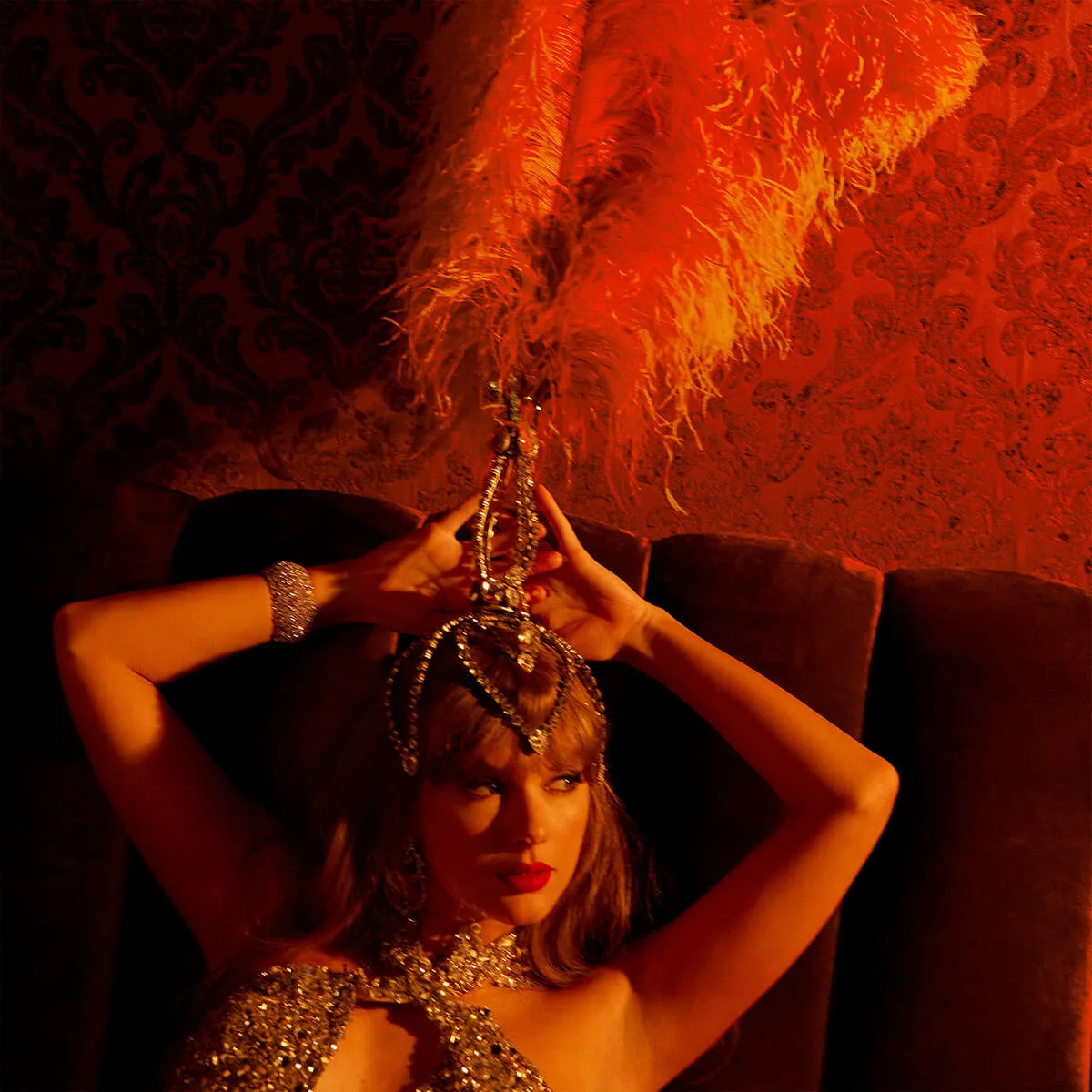
Photograph published in Taylor Swift’s official era archive · Source ↗A close portrait framed by orange feathers
Photograph published in Taylor Swift’s official era archive · Source ↗Feathers, jeweled surfaces and theatrical lighting make the chapter’s central role recognizable at a glance. The official gallery moves between close portraits and larger performance images, letting the same visual vocabulary work at different distances. A small ornament can matter in one picture while the whole silhouette carries the next.
The contrast between orange and green imagery gives the presentation more than one temperature. The warmer scene feels dense and staged; the cooler image gives the figure another kind of surrounding space. The clothes help connect those settings without requiring every photograph to repeat the same pose.
The most interesting detail is the relationship between the performer and the apparatus around her. Feathers, light and costume establish a public image, but a face and a gesture can pull attention back toward the person occupying it. That friction gives the showgirl idea more dramatic possibility than glamour alone. [1]
A new role can answer an older song
The opening names Ophelia and Elizabeth Taylor place the record beside already familiar stories of women being imagined and seen. The later title-track duet gives the showgirl role company. Those choices make the chapter’s public image a conversation with inherited roles rather than simply another claim to novelty.
It is rewarding to compare the period with 1989’s staged romance and reputation’s multiplying personas. Each chapter uses performance to ask a different question about visibility. The comparisons do not make the newer work a repetition; they reveal how an established artist can return to a concern through another visual and musical setting.
Enter through The Fate of Ophelia, the official gallery and the title-track duet. The route moves from a recognizable story to a constructed image and then to a shared voice. It gives the chapter a clear identity while leaving room for the more ordinary wishes and relationships that the album places inside its theatrical frame. [1]