In this story
The Life of a Showgirl’s official gallery gives costume a very large share of the picture. Feathers can surround a face, extend a body or multiply across a group of performers. Jeweled surfaces make the figure feel constructed for light, while a cool green setting offers another temperature beside the dominant orange.
The photographs invite two kinds of looking: a wide view of spectacle and a close encounter with a person inside it. Their strongest connection is the movement between those scales. An extravagant visual role becomes more interesting when the performer’s face and hands remain part of the scene. [1]
The feathers occupy the room
A jeweled costume in a cool green setting
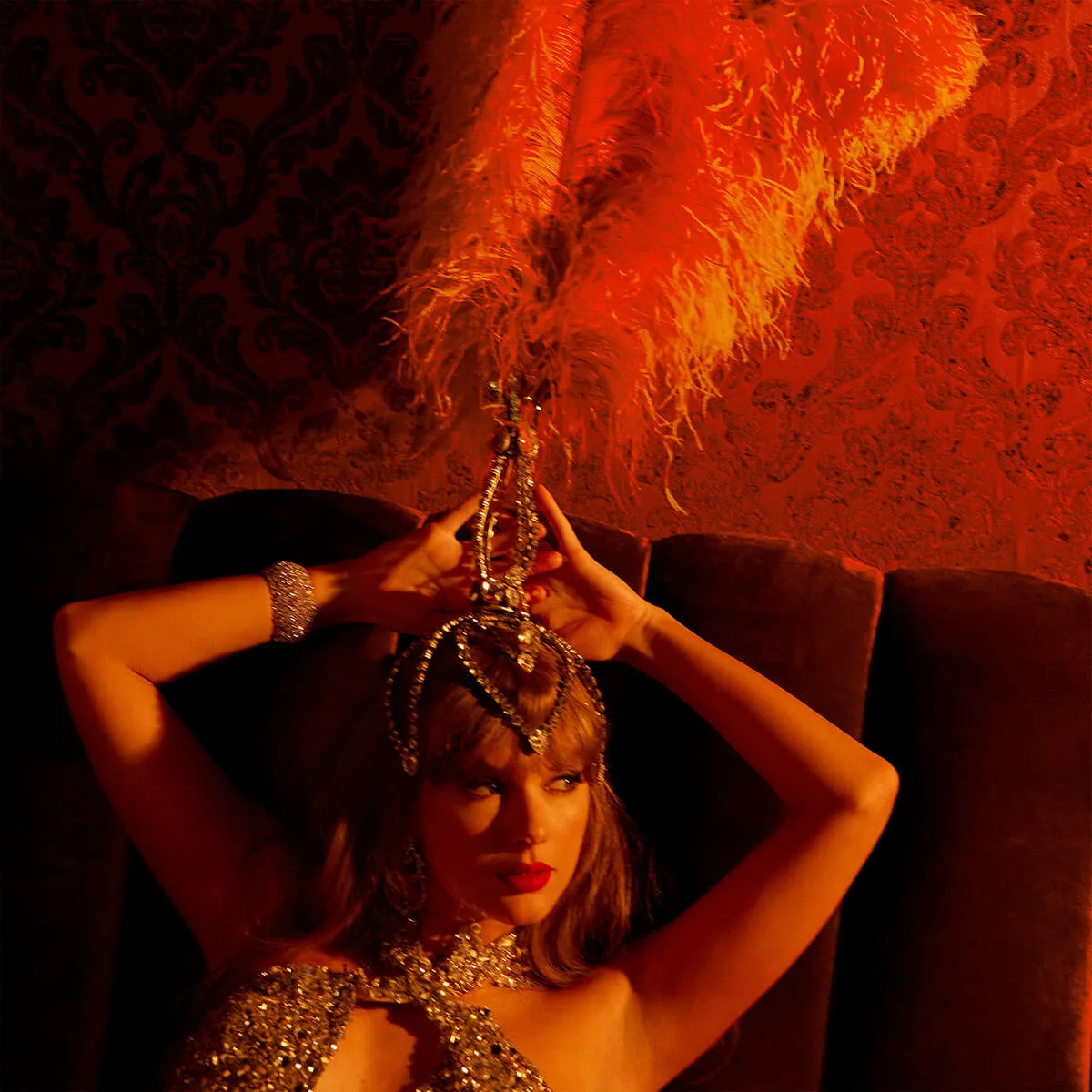
Photograph published in Taylor Swift’s official era archive · Source ↗The orange image around the reclining figure makes the costume and its surroundings feel almost continuous. The material fills space behind the body, so the outline is defined as much by the surrounding plumes as by the garment itself. A pose can seem contained inside a larger decorative world.
The wider image with multiple performers distributes that volume across a group. Yellow feathers repeat, turning individual costume elements into a shared visual rhythm. A single figure may still hold the center, but the spectacle depends on the company around her.
The contrast is especially interesting beside the album’s title-track duet with Sabrina Carpenter. A theatrical role can be singular in one scene and shared in another. The gallery lets that possibility become visible, showing how a showgirl image gains some of its scale through other bodies, repeated shapes and an organized surrounding space. [1]
A close portrait lets the person return
Feathers repeat across a group of performers
Photograph published in Taylor Swift’s official era archive · Source ↗A portrait framed by an orange headdress
Photograph published in Taylor Swift’s official era archive · Source ↗The green portrait changes the atmosphere without abandoning the jeweled costume. Its cooler setting places the body within another field of color, and a hand near the face gives the composition a smaller gesture to follow. The scene feels less dependent on the wide sweep of feathers.
In the orange close portrait, the headdress acts as a frame. The face sits inside an elaborate boundary, with the dense decoration making the expression more conspicuous rather than erasing it. The wearer is visibly part of the construction, but the eye can still return to a human scale.
That is what gives these images more interest than costume excess alone. The large apparatus establishes the public role; the small gestures prevent it from being the only subject. Look back after hearing The Fate of Ophelia and the closing duet. The album’s theatrical naming and the gallery’s varying distances can then work together, leaving the listener with both a spectacular image and someone occupying it. [1]