In this story
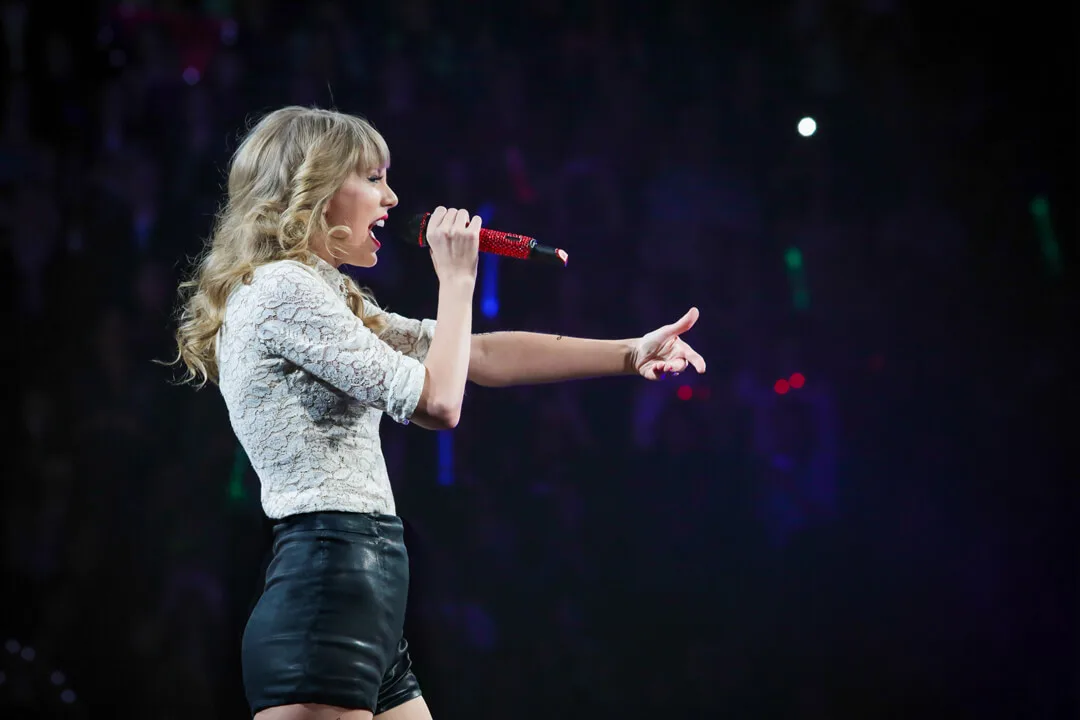
The official Red gallery shows how much an image can do with a limited set of colors. Pale shirts and dark shorts establish a simple figure, then a red microphone becomes a concentrated accent. Elsewhere, the body settles beside a piano or the guitar supplies the strongest colored shape in the frame.
The chapter’s name does not require every surface to be red. Its most effective pictures often let the color arrive in a single place. That restraint gives an ordinary stage object the visual force of a signature while leaving faces, gestures and instruments easy to notice. [1]
The microphone becomes the punctuation
A dark dress beside the piano
Photograph published in Taylor Swift’s official era archive · Source ↗A pale upper body against dark shorts makes the performer’s outline quick to recognize. The red microphone adds a compact point of attention near the mouth, connecting the color to the act of singing rather than spreading it across the entire costume.
The closer photograph changes the balance. A patterned shirt supplies more texture, but the microphone still interrupts the picture as a distinct accent. The object can connect wide and tight compositions because its shape and color survive the change of scale.
This economy suits a record with such different ways of making an address. We Are Never Ever Getting Back Together turns refusal into a bright public declaration, while All Too Well lets remembered particulars accumulate. The photographs provide a similarly flexible vocabulary: a simple outline, a highly visible object and a face that can carry a change of emotional pressure. [1]
An instrument can become the setting
The red microphone in a closer view
Photograph published in Taylor Swift’s official era archive · Source ↗A red guitar against a pale shirt
Photograph published in Taylor Swift’s official era archive · Source ↗At the piano, the performer no longer needs to carry the central instrument. The dark surface occupies space beside and in front of her, giving the image a more settled geometry. A seated body changes the pace of the picture, even before a listener imagines which song might be played.
The red guitar supplies another arrangement of the same elements. Its colored body rests against a pale shirt, while the purple-lit background keeps the object distinct from the surrounding scene. The stage palette expands without losing the recognizable red accent.
The comparison is useful because wardrobe does not work alone. A shirt, a dress or a pair of shorts gains its stage meaning through nearby objects and the position of the body. These four photographs make that relationship unusually clear. After hearing State of Grace and the quietly paced Sad Beautiful Tragic, the gallery can feel like a visual range of the record’s changing distances, from an outward-facing declaration to a quieter room. [1]