In this story
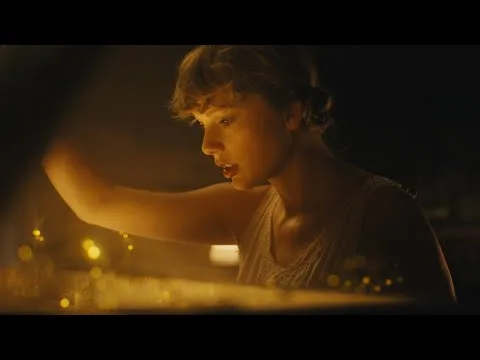
The cardigan video begins with an instrument that seems to belong safely inside a room. Then the piano becomes a route out of it. A familiar object takes the performer into environments whose scale and atmosphere are increasingly difficult to control: lush growth, open water and a return to the original cabin.
Released alongside folklore on July 24, 2020, the film was written and directed by Swift, with cinematography by Rodrigo Prieto. Its fantasy gives the song’s remembered intimacy a visible geography. The journey ends where it began, but the person who comes back carries the experience into the room. [2]
Watch the video
Watch the official music video written and directed by Taylor Swift.
YouTube could not play this video here. Open it on YouTube to keep watching.
The cabin makes the first world feel held
The opening room brings the performance close to ordinary objects: the instrument, nearby pictures and small sources of light. The frame feels contained. There is a place to sit, a surface to touch and a recognizable relationship between a person and the space around her.
That containment makes the first departure significant. The piano is not simply abandoned when fantasy arrives. It becomes the connection to another environment, carrying the act of making music beyond the room’s boundaries. An object associated with expression becomes a means of movement.
The transition also changes the instrument’s apparent role. In the cabin it can seem stable and familiar. Once it connects distant settings, it starts to behave like something that can guide a person without promising where the guidance will end. Familiarity and uncertainty remain attached to the same object. [1]
Enchantment fills the frame
The forest setting surrounds the performer with growth and a more expansive atmosphere. The piano remains recognizable while the surroundings change, so the scene can feel continuous and fantastical at once. The viewer has something familiar to hold onto inside an unfamiliar world.
Swift’s official scene commentary associates this landscape with the enchanting beginning of a relationship. The visual pleasure has an important scale: the world around the person seems to have become more alive. Feeling is not limited to an expression on a face; it occupies the environment.
That expansion supplies a counterpart to the song’s small remembered details. A place or an object can become emotionally enormous even if it remains ordinary in another account. The video turns that disproportion into scenery. The surroundings make the attraction visible before the next setting changes its conditions. [1][2]
The instrument becomes something to hold onto
Open water removes the security supplied by the room and the inviting abundance of the forest. The instrument is now encountered under conditions of exposure. Something that previously enabled movement becomes a point of contact in a setting whose motion is difficult to manage.
The official commentary connects this part of the film with fear and loneliness as a relationship breaks down. Its effectiveness also comes from the change in what surrounds the performer. There is less shelter, less certainty about footing and a much greater distance between the person and a stable interior.
The film does not have to introduce a second visible character to make relational difficulty legible. It lets the environment change the performer’s position. The contrast with the earlier landscape gives isolation a shape: an expansive world that once felt welcoming can become a place in which someone struggles to remain held. [1][2]
Home is familiar; the return is not untouched
The cabin returns as the final setting. Its familiarity supplies relief, but the visible aftermath of the journey prevents the ending from becoming a reset. The official commentary specifically connects the wet clothing with having been changed by the experience while recovering a sense of self.
That distinction makes the return more interesting than a simple escape from danger. The room can offer a place to recover without erasing what happened outside it. The cardigan’s ordinary warmth gains force because the performer has moved through a world in which protection became uncertain.
The song’s narrator similarly carries recognition and hurt together. Understanding an experience does not make it disappear. The video gives that persistence a concrete form: a person can come back to a familiar place and still bring the journey with them. [1][2]
A small room opens onto a larger album
The official commentary identifies the photograph in the cabin as Swift’s grandfather Dean, also connected to epiphany. It identifies the nearby house painting as a work Swift made early in isolation. These details make the opening room more than a generic fantasy interior: it contains particular objects with histories of their own.
The film’s larger achievement is how it keeps those small anchors beside its changes of scale. Personal objects remain meaningful within an imagined journey. The video can move into enchantment without making the original room irrelevant to what follows.
This is also a useful companion to folklore’s changing narrators. The album often lets a familiar object or scene mean something different when another voice encounters it. Here the instrument visibly changes its function across settings. The continuity allows the changes to register; the thing that remains is what makes each new world feel different. [1][2]