In this story
At the 2021 GRAMMYs, the visual world around folklore became a place the musicians could enter. A moss-covered cabin gave the performance a roof, an interior and a sense of shelter. The movement through that setting connected three songs without asking them to tell exactly the same story.
The ceremony took place on March 14, 2021. Swift performed cardigan and august from folklore, followed by willow from evermore, and folklore won Album Of The Year. The performance and the award made different parts of the chapter visible: one offered a miniature musical world, while the other recognized the album as a complete work. [1][2]
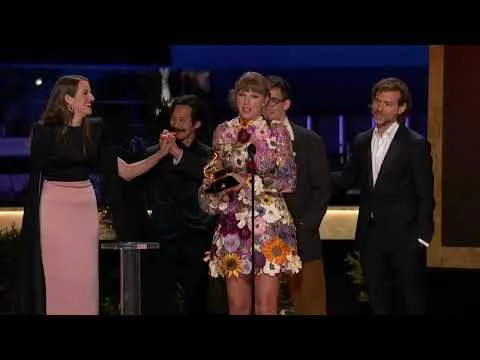
Watch the acceptance speech
Watch the Recording Academy’s official Album Of The Year acceptance speech for folklore. The performance is discussed below.
YouTube could not play this video here. Open it on YouTube to keep watching.
A forest becomes a place to play
The performance began with cardigan on a moss-covered cabin, then moved inside for august, with Jack Antonoff and Aaron Dessner joining Swift. The scene gave the songs a shared location without requiring their narrators to become one character. A place could hold several stories at once.
That was a particularly apt way to translate folklore to a televised stage. The album’s cover and cardigan’s video had already made wooded settings part of its visual vocabulary. A cabin adds the possibility of gathering: somewhere the musicians can occupy together, rather than a distant landscape that only surrounds the singer.
The transition from the roof into the interior also supplies movement without demanding a constant change of spectacle. The audience follows an entrance, and the next song feels as if it has been found within the same world. The set makes continuity visible while the change of song introduces another emotional position. [1]
Three songs, two albums, one short journey
The medley concluded with willow, from evermore. That distinction matters: the performance reached beyond the album competing for the evening’s main prize. It placed folklore beside its companion record, letting the stage suggest an ongoing musical world rather than a chapter already closed by an award.
The sequence also offers a useful listening contrast. Cardigan looks back across a complicated history; august lets remembered possibility expand; willow brings a more circling sense of attraction. Those are different emotional movements, and the shared setting lets their differences register without making the medley feel disconnected.
A medley cannot reproduce the pacing of three complete recordings. Its task is to establish enough of each song’s character for the movement between them to feel worthwhile. Here, the cabin provides a consistent frame while the selection changes the mood. The stage tells a compact story about the records’ relationship, even as each song retains a separate place on its own album. [1]
The collaborators come into the picture
Seeing Swift, Antonoff and Dessner in one setting gives the collaboration a public image. On a record, different contributors can be audible without the listener picturing their working relationship. A performance places bodies beside those sounds and makes the act of playing together part of what the audience remembers.
That image is useful without suggesting that the three visible musicians represent every contribution to folklore. An album’s credited work extends beyond the people occupying a particular stage. The performance makes one collaboration legible; the recording’s full credits tell the broader story.
The emphasis on musicians sharing a relatively compact setting also suits the record’s closeness. The cabin can be elaborate as television scenery and still create the impression of a small room. That tension is productive: an intimate musical language finds a form large enough for an awards broadcast without abandoning the attraction of people playing within reach of one another. [1]
An album award gives the evening another scale
Folklore won Album Of The Year. It was Swift’s third win in that category and her eleventh career GRAMMY at the time. She accepted alongside Antonoff and Dessner, wearing a floral-print dress. The photograph of an awards moment and the cabin performance offered two different public images of the same musical chapter.
The category recognizes an album, so the result asks the listener to consider the whole record rather than only the songs selected for the broadcast. The medley had made a handful of pieces visible; the award returned attention to the larger sequence, including its changes of voice, arrangement and narrative distance.
For someone discovering folklore through this appearance, the most rewarding next step is the record itself. The studio versions restore the space around cardigan and august, while the songs between them explain how different stories inhabit the same album. The evening is an inviting entrance into that world, and the official acceptance speech preserves the separate moment when the work received its award. [2]