In this story
Fearless gives a first encounter the scale of a storybook possibility, then discovers that not every promise can be kept. Around the album, that contrast becomes a public world of romantic videos, glittering performance clothes and audiences large enough to answer a chorus together.
The record was released on November 11, 2008. The official tour archive begins in Evansville on April 23, 2009 and follows the shows into 2010. This guide looks at the translation from a young narrator’s detailed scene to a performance people could inhabit collectively, while the album page follows the thirteen-song listening sequence. [1]
Love Story supplies a world you can enter
The Love Story video gives the song’s romantic proposition a visibly separate world. Costume and setting let the viewer recognize an inherited fairy-tale language before the chorus reaches its resolution. That is an efficient visual invitation: the audience already understands what sort of obstacle and relief the scene is preparing.
You Belong With Me offers a much more everyday route into the same wish to be recognized. Its school setting makes proximity the central frustration. Moving between the two videos shows how the chapter can use a grand romance and a familiar social situation without abandoning its direct emotional address.
The pairing helps explain the era’s broad invitation. One listener can enjoy escaping into a costume story; another can find a recognizable version of an ordinary day. The songs do not have to occupy the same fictional world to become part of the same public chapter. [1]
A chorus acquires a crowd
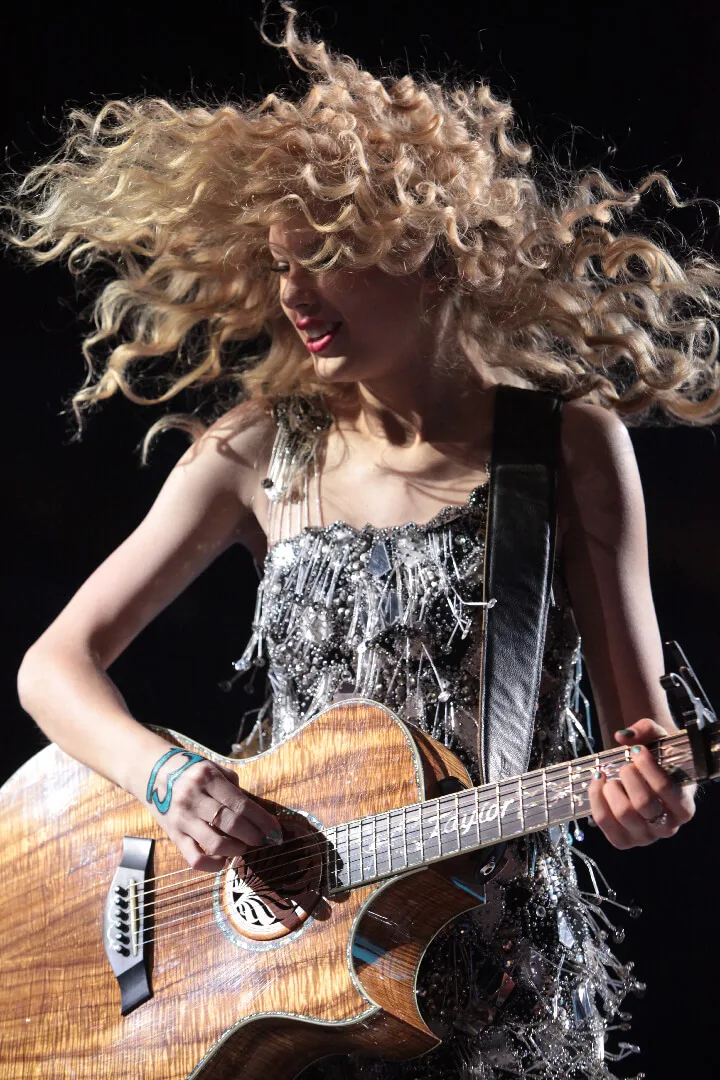
A sparkling dress and acoustic guitar onstage
Photograph published in Taylor Swift’s official era archive · Source ↗The guitar raised above the stage
Photograph published in Taylor Swift’s official era archive · Source ↗The stage photographs give the guitar another partner: clothes whose surfaces catch light as the performer moves. Fringe and shine make motion visible at a greater distance. The singer remains associated with the instrument, but the surrounding presentation can now supply a sense of event.
The first headlining tour expands what the songs can do socially. A refrain written from a particular narrator’s position becomes something many people repeat at once. That change does not remove the story’s specificity; it lets different listeners bring their own versions of it into the same room.
The chapter also reached a defining awards moment with Fearless winning Album Of The Year at the 2010 GRAMMYs. The public recognition and the tour tell related stories about scale, but their pleasures differ. One acknowledges the album as a work; the other makes its scenes into shared evenings. The later Taylor’s Version returns to those songs from another point in the career, and belongs to its own recording page. [1]