In this story
Speak Now’s official gallery makes the stage wardrobe feel like a collection of dramatic possibilities. Some images keep the figure compact and mobile; others extend the dress into a larger shape. The contrast suits a record that can move from the quick romantic lift of Sparks Fly into the long recollection of Last Kiss.
The four photographs here come from the official chapter archive. They are grouped for their visible silhouettes and colors, without assigning an unconfirmed designer to each garment. Their interest lies in how the clothes change the performer’s relationship with the space around her. [1]
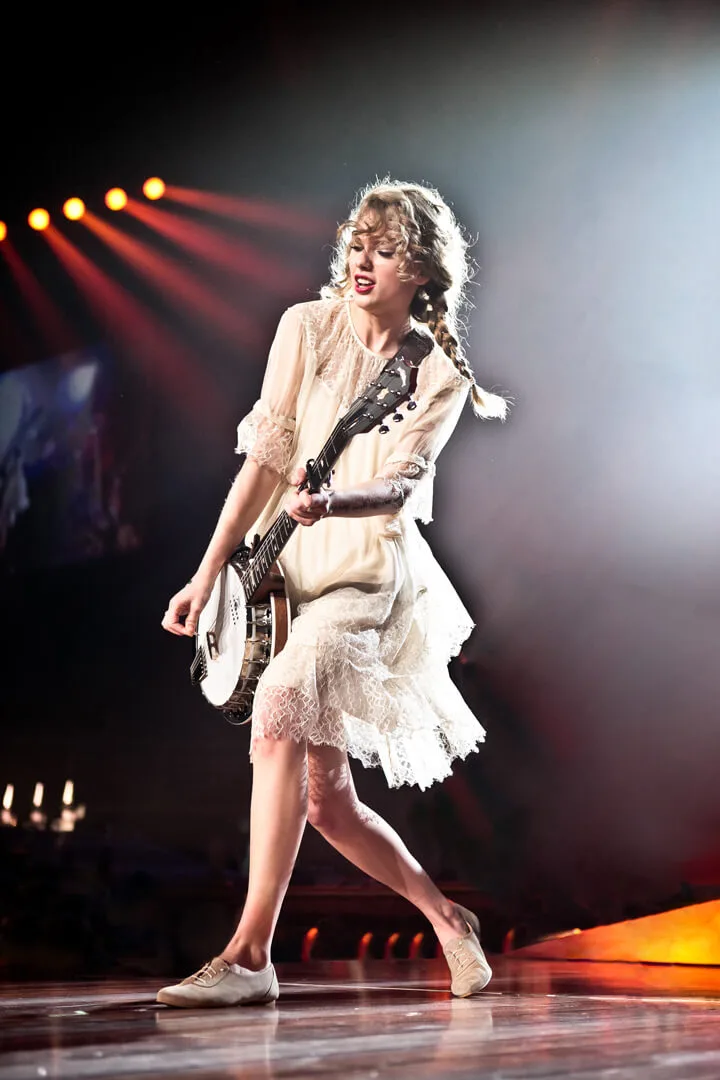
A short silhouette leaves the body available
A seated guitar performance in black
Photograph published in Taylor Swift’s official era archive · Source ↗The pale, fringed stage dress keeps the outline close to the body while allowing the lower edge to move. Its light surface can remain visible against a darker setting, and the compact shape leaves the legs and arms central to the pose. The garment gives the performance a bright outline without becoming its whole environment.
The black dress in the seated guitar photograph reduces the surrounding color even further. The eye can follow the hands, the instrument and the bend of the body. Sitting changes the silhouette, so the same general category of short dress begins to serve a very different kind of scene.
Those two settings make an interesting pair with Mine and Never Grow Up. One song can move quickly toward an imagined future while the other asks a listener to stay with the cost of growing older. The clothing does not explain either song, but it makes the stage capable of supporting both energetic movement and a more contained address. [1]
A gown gives the song another horizon
The purple gown extends the figure
Photograph published in Taylor Swift’s official era archive · Source ↗A cool blue gown within the stage setting
Photograph published in Taylor Swift’s official era archive · Source ↗The purple gown extends the figure vertically and lets fabric occupy more of the frame. Instead of a short moving edge, the viewer gets a larger, more continuous surface. A relatively small upper-body gesture can then sit above a silhouette that already feels expansive.
The cool blue dress changes the atmosphere again. Its pale color establishes a different relationship with the surrounding stage image, giving the chapter another temperature. Seen beside the purple photograph, it demonstrates how changing a single large field of color can alter the emotional impression of the whole composition.
These longer silhouettes are especially inviting beside Enchanted and Haunted, songs whose arrangements allow an encounter to become almost architectural in scale. The clothes offer a visible partner to that expansion. Returning to the compact guitar photograph afterward makes the gallery feel more varied: theatricality can grow from an enormous dress, but it can also live in a held pause and a seated figure. [1]